
Getting To Grips With Semantics: Why Language is Crucial for Scientific Writing
By Kate Spear, Sub-editor
Technical and scientific writing should be accessible and understandable, without compromising on accuracy. While this borders into the realm of social science, considering the semantic density and semantic gravity of individual works (or phrases) is a key tool in the writing of compelling content, and understanding the role of semantic waves within communication can be a game-changer.
It’s not what you said, it’s how you said it
It’s highly likely that at some point in your life you’ve become lost in the weeds of technical jargon; be it a written paper, webinar, lecture, or even a televised documentary detailing with a complex or abstract subject. It’s happened to us all! And this feeling isn’t exclusive to those from a non-academic or non-technical background. Even with years of experience and substantial technical expertise, it can be the case that industry-specific terminology or acronyms can be overwhelming, especially when reading a technical paper or listening to a live talk.
This short blog post will outline the importance of considering language used when writing articles for clients, and highlight a key framework that we use at ConsultaChem to ensure our outputs remain interesting, accurate and audience-specific.
NB: this piece is based on work that we published in the academic literature in 2020.
The accessibility and accuracy balance
Language and its use are inherently human, yet when reading or learning about science, in some cases it can feel like it’s written in a different language. And (to some extent) this is technically true: many scientific terms are based on Greek and Latin, and while these terms may eventually become well embedded within your scientific vocabulary, it’s unlikely that those outside of the field will be using them in day-to-day life.
Having an appreciation that scientific language is complex is crucial for excellent scientific writing, with striking an appropriate balance between accessibility and accuracy being a key objective. Knowing your audience is vital – ranging from industry experts, investors, scientists from neighbouring fields, or business leaders – and content should be tailored for their understanding, clearly reflecting what they need to know. Lose your audience too quickly and it doesn’t matter how ground-breaking your science is, very few people will read it.
Science in the public domain
In the modern era, it’s rapidly become clear that science does not exist inside a bubble, which is increasingly reflected in the requirement for impact and evidence case-studies for key innovations. New findings, ideas and theories increasingly need to be shared with both scientists and non-scientists alike, for example, investors, regulators, customers and policy makers. With this audience diversity, an appreciation of the intended audience is key, and if they can’t understand the science behind your research or product, then how will their attention be maintained (or investment be persuaded)?
It’s necessary, as a writer, to put yourself in the shoes of your audience:
What would make me want to engage with this product/service/instrument?
Why does the reader need this item/service?
This balance can be hard to strike: too accessible and some of the nuances in the science will be lost, potentially leading to inaccuracies and loss of interest from technical audiences. On the other hand, being too specialised risks losing interest and giving rise to a lack of understanding. Furthermore, it could be argued that writing science for non-technical readers is the most crucial of all, as it’s common for businesses to require investment and development from colleagues with a non-scientific background.
The Curse of Knowledge
Most people are familiar with the fictional consulting detective Sherlock Holmes, who can read crime scenes like books, yet completely fails to communicate effectively with the other characters and relies on Dr Watson to translate for him. Sherlock Holmes is experiencing the curse of knowledge, a cognitive bias where, once knowledge is gained, it becomes harder to imagine what it was like to be ignorant of it and the assumption is made that everyone else has the same level of expertise.
It’s extremely easy to fall into the same trap when writing scientific content; relying heavily on technical jargon and industry specific acronyms that mean one thing to the writer but might have a different definition to a reader. Assuming knowledge may also impact the tone of the piece. Tone influences and guides the reader through the piece and is crucial for matching the language to the audience. Language choices (too formal or informal) will impact the credibility of the content and the key messages taken away. To avoid falling for these traps, it’s important to consider semantics, and how it can make scientific language difficult to follow.
Semantic density and semantic gravity: crucial to manage for accessibility
It’s often the case that scientific words are used in everyday life. However, the amount of meaning or inferred understanding beneath the word can be substantially different. We’ll introduce this concept through use of an example, by considering the word ‘alcohol’.
In an everyday context, ‘alcohol’ usually refers to a beverage containing ethanol, for example wine or beer. However, when discussing the world alcohol in a chemical setting, a great deal more information needs to be quickly and accurately ascertained: is the species being discussed primary, secondary or tertiary? Is it acting as a solvent or a nucleophile? Do I need to worry about any orbitals or lone pairs of electrons. In short, the meaning underneath a word is dependent on the context, which determines the level of associated unspoken knowledge.
The relationship between a word and its underlying meaning is described through Legitimation code theory (LCT), a framework that provides a method for separating out complex and abstract ideas, usually within written communication.
The degree of abstraction is termed semantic gravity (SG)
The degree of complexity is semantic density (SD).
The stronger the SG, the less abstract a concept is (or it can be easier to think of it as more ‘grounded’). For example, a factual or observational concept is deemed to have strong SG. E.g. during quench of a copper-containing reaction, the copper can cause the aqueous phase to go blue. This is categorised as having strong semantic gravity as you can see it and it’s a statement of fact. Once you start adding discussions around why they aqueous phase turns blue, the SG will start to weaken, as this requires more abstract discussion around metal ions, hydration spheres, d-splitting etc.
For SD, the more complex the definition or idea attached to a word or phrase the stronger semantic density. Taking the alcohol example earlier, in an everyday sense alcohol has weaker semantic density as it’s primarily considered a drink, with nothing more to add. However, discuss alcohol in a chemical-setting and suddenly the SD strengthens rapidly: what type of alcohol is it? How nucleophilic is it? Is there more than one alcohol present? There’s more to consider, and the interlocutor or reader really needs to think quickly and get up to speed fast.
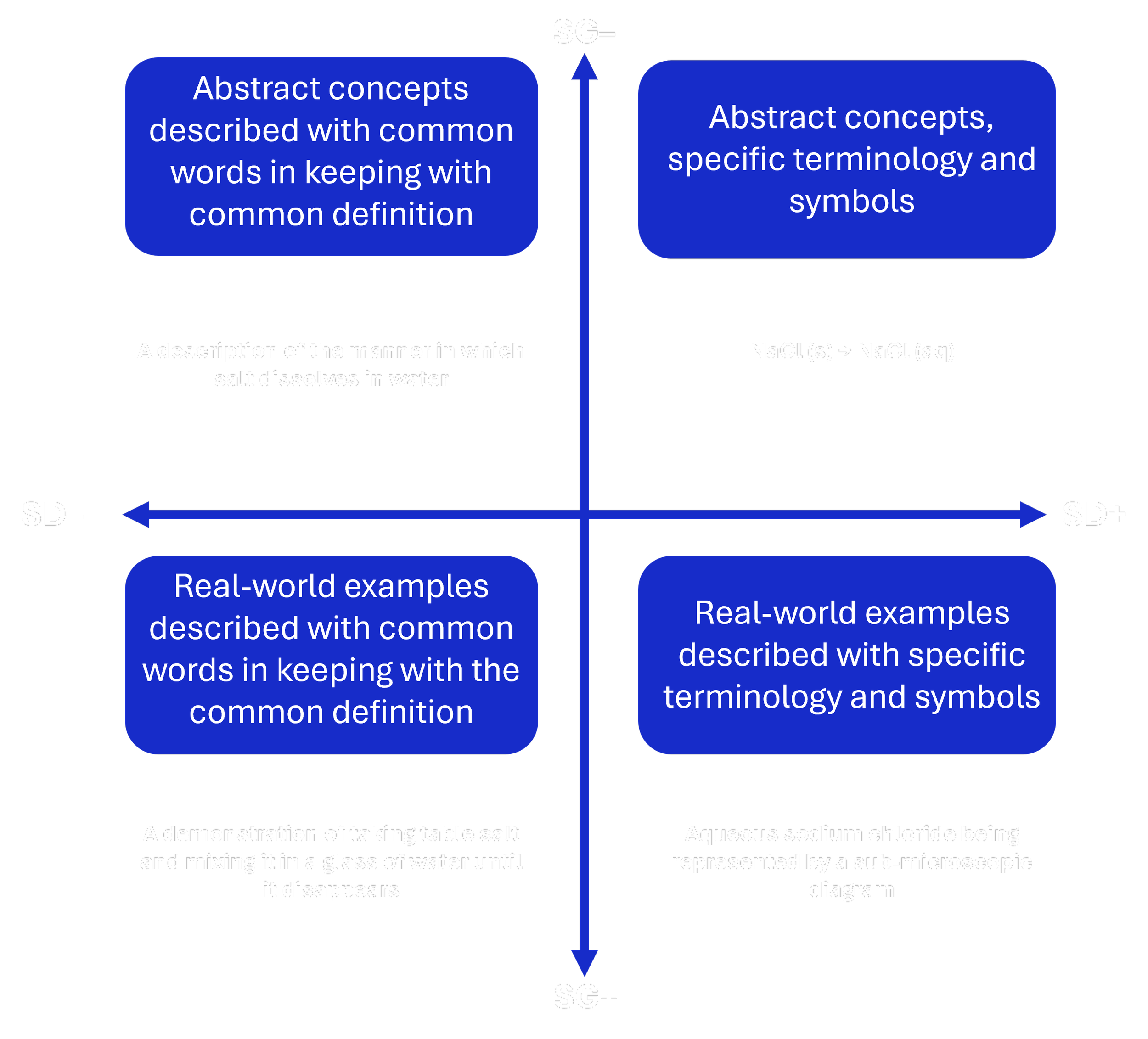
It should be noted that SG and SD are independent of each other, and can change with the language used so that each is relatively stronger or weaker. It should also be noted that throughout a piece of discourse, or written content, the SG and SD can weaken and strengthen, leading to semantic waves. The use of semantic waves is an extremely important educational tool, and vital for maintaining the interest of the reader. A good piece of writing will use semantic waves throughout, with SG and SD strengthening and weakening to underscore certain aspects or take-aways from the piece. In short, varying the strength of SD and SG in a piece is a useful tool to aid understanding and underscore key takeaways.
Hierarchical knowledge structure: a scientific quirk
However, as is often the case (especially in science!), scientific discourse is further complicated by its hierarchical knowledge structure, a concept outlined by the sociologist Bernstein.
In hierarchical knowledge structures, the accumulation of expertise relies on building on and subsuming new knowledge into existing concepts. This is true for all sciences, where a thorough understanding of any area requires the use of knowledge from a lower tier of the hierarchy.
However, this cumulation of knowledge may not be obvious on the outset. Take a chemical bond, which can be simply represented on the page as a single line. As expertise grows the meaning of that simple line changes, growing to include Lewis structures, dipoles and polarisation, orbital hybridisation, then molecular orbital theory (if you really stick at it!). The point of this section is an acknowledgement that what each person takes away from the same representation differs with their level of knowledge.
Why is it important in science?
Science aims to describe the physical observations we see every day and explain how and why our world works the way it does. Often the topics or concepts we are endeavouring to describe have no real-world equivalent and cannot be physically experienced – or can only be observed using specialist instrumentation. Consequently, concepts may not be intuitive, an issue potentially exacerbated by scientists unconsciously using everyday terminology that carries certain implications, without intending those implications to be applied to that specific context.
The idea that scientific language is complicated is not a new problem. Lavoisier commented on the impossibility of separating scientific language from the science itself in 1790 – over 200 years ago! Essentially, he described that to become an expert within a scientific discipline, scientists need to learn an entirely new language to fully comprehend the technical scope and depth of each concept.
The importance of symbols
Semantic density is not limited to the use of technical terminology or jargon – it also covers the use of symbols. Commonly used in chemistry, engineering and physics, symbols provide a quick shorthand for communicating complex concepts.
An incredibly famous example of this is Einstein's mass-energy equivalence – ‘E = mc^2’ – a deceptively simple equation describing the relationship between energy and matter, a key concept underpinning many theories. In chemistry the use of chemical symbols to represent substances and convey chemical transformations is central in the day-to-day of a chemist, think of using ‘Au’ instead of ‘gold’ and all the cumulative knowledge contained within those two characters: electronic configuration, atomic number, metallic bonding and catalytic ability. The use of these symbols can be considered a ‘meta-language’ as there is a predetermined syntax and accepted use of each one, for example within molecular formulae where syntax implies the bonding.
Scientific writing by scientists for scientists
When communicating science to a wide range of audiences, there is an art in selecting the appropriate language. Written communication for marketing purposes needs to be accurate but ensure that the ‘translation’ of technical jargon into the everyday lexicon does not change the inherent or implied meaning of the piece. It is not uncommon for marketing materials to be produced by individuals who are not fluent in scientific language, leading to unintended inaccuracies. Conversely, not all technical teams are able to effectively translate their work into suitable marketing materials. The challenge lies in striking the balance between clearly explain the technical aspects without overwhelming the reader and grounding explanations in real world examples using common language. Of course, this comes with the caveat that the translation of technical jargon and simplification does not lead to misunderstanding or change the meaning. There is skill in conveying the nuances in an accessible manner that is not always appreciated.
The technical rigour required to produce high-quality scientific writing and marketing should not be understated. In the emerging age of artificial intelligence (AI), many of us are turning to large language models (LLMs) like ChatGPT, Claude or Co-Pilot to create written content for a wide variety of audiences. While, in a multitude of scenarios, the use of AI can speed up this process, it is not always applicable. When writing about complex scientific processes and procedures these LLMs lack the years of experience and learning gained from using real-world experts in their fields. Furthermore, human generated content has been shown to out-perform AI content within a scientific setting. Audiences subconsciously critique the author’s experience within the area and if the perspectives shown relate to explicit real-world experiences or originate from synthesised knowledge. Readers are able to identify this gap between genuine and generic, resulting in lower rates of engagement with AI generated scientific content. To ensure our outputs are the best for our clients, the ConsultaChem standard is not to use AI, which you can read more about on our insights page.
The ConsultaChem standard
At ConsultaChem we understand and appreciate the challenges around scientific communication. Our highly qualified team of sub-editors are experts in their fields, with real insights into the semantics of a concept, allowing our pieces to be accessible without compromising on precision.
We can readily embed ourselves into technical and marketing teams, bridging the gap between specialist and commercial knowledge. Collaboration with our clients ensures that content establishes technical authority without the requirement for large in-house content teams.
We know that good technical writing requires an understanding of the field, providing and explaining the correct context, and presenting it to the audience in an appropriate way. We love to learn about new products or services and have a genuine interest in sharing our clients’ successes through high-quality materials that meet their needs. If this is of interest then get in contact, we’d love to hear from you.