Long-Form Content to Drive Web Traffic
Preparation of technical online content and newsletter items that bridge the gap between technicality and accessibility, with a view to driving website traffic.
What We Did
We regularly use long-form content for our clients to drive web traffic. In this case, our client is the US-based specialist in claims substantiation – primarily within the cosmetics and personal care industries – TRI Princeton.
The original brief when we started our partnership was to prepare articles that were scientifically accurate, yet accessible to those working in cosmetic science who may not have majored in chemistry. These posts were to serve as a foundation for increasing online presence, as well as supporting the educational strand of the business. While this brief has since expanded, the original intent remains.
When writing articles for TRI there are two approaches that we broadly take: some articles are instrument-centric (showcasing the capabilities of a particular instrument or technique) and some articles are customer-centric (discussing the types of claims that their customers are likely to want to make, and how these can be substantiated). For both approaches, a sound knowledge and understanding of the fundamental scientific rationale and approach is essential, along with the ability to explain these fundamentals accurately and concisely.
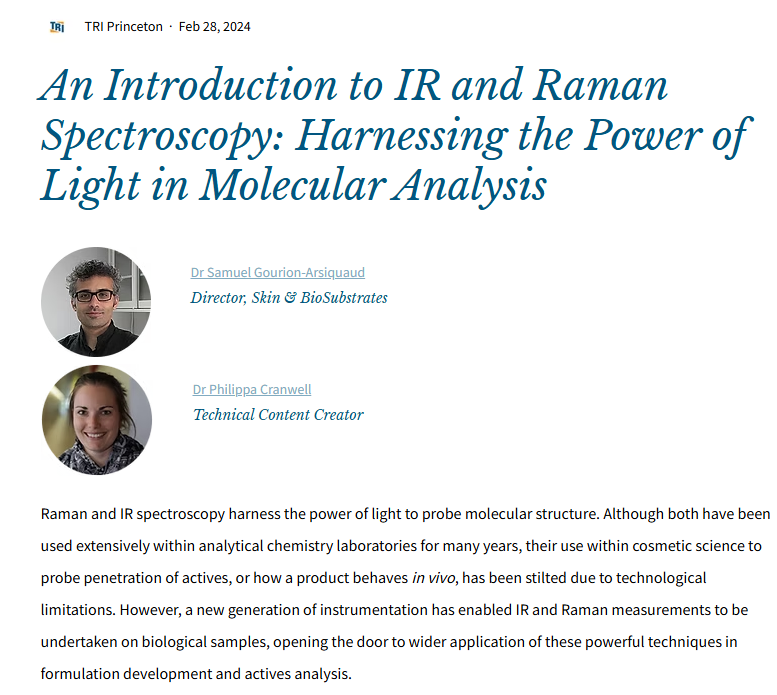
While we have written numerous articles for TRI, the one that we’re most pleased with is relating to the science behind IR and Raman spectroscopy, particularly within claim substantiation. Crucial to the success of the piece was the inclusion of several core themes, including:
What IR and Raman spectroscopy are
How they both work from a scientific perspective (including some fundamental physics!)
Key examples of their use, while ensuring that any proprietary information was not disclosed
Why It Matters
TRI Princeton is an independent, not-for-profit, scientific institute with world-leading expertise in applied measurement sciences and a global reach. The key word here is ‘expertise’ – they’re a leader in their field.
We’ve worked with TRI since our beginning, and we’re conscious that our output represents their client-based testing and research business that’s been built up over nearly a century. One of our main roles is to provide blog content, both long-form and short-form, to drive traffic and growth. And it’s working. Without giving too much away, since we started working together:
Website traffic is up
Client engagement is up
Reach is up
And this is in part down to the quality of the content that we create, as well as our integration within the marketing team. We’re always careful to be scientifically accurate, and in some cases we bring in external expertise from our extended network.
The ConsultaChem Difference
Our ability to convey complex scientific contexts within cosmetic science to non-chemists is crucial for engagement and success, a skill honed from being an academic for nearly 10 years at the University of Reading.
From an editorial perspective, communicating cosmetic science requires a balance of scientific rigour and accessibility, which is where we excel. We ensure that everyday examples are included so context is given, and, when appropriate, give the scientific underpinning needed to support deeper understanding by the reader. We also prepare all the diagrams, to ensure clarity of the piece and consistency within site.
Conclusion & Related Reading
TRI are great clients, and we’re part of the team. Importantly, they trust that we deliver content that is factually accurate and within deadlines.